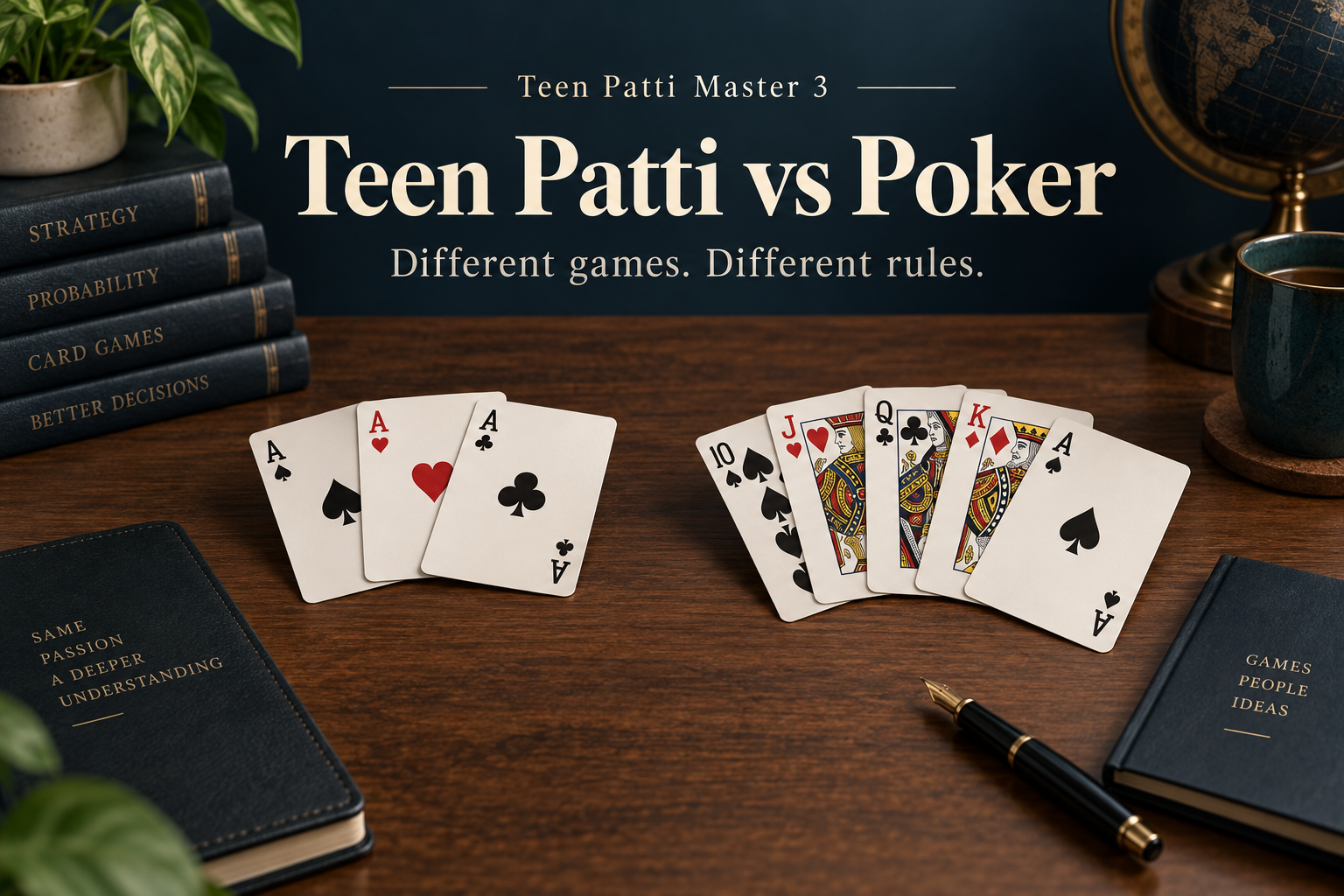
Teen Patti and poker can look similar when you first see the cards on a table. Both use familiar suits and ranks, and both ask players to recognise combinations rather than simply add card values. That resemblance is also where many beginner mistakes start. A rule remembered from one game can sound convincing in the other while producing the wrong answer.
This guide compares classic three-card Teen Patti with standard five-card poker hand ranking. It is for adults learning with a physical deck, without money or anything that can be redeemed for money. It does not recommend an app, explain deposits or promise a way to win. The aim is narrower: understand which rules belong to which game before you compare two hands.
TL;DR: Are Teen Patti and poker the same game?
No. Classic Teen Patti gives each player three cards. Standard poker hand ranking evaluates five-card hands, even though particular poker variants may give players more cards from which to choose. The category order differs. In Teen Patti, a sequence beats a colour. In standard five-card poker, a flush beats a straight. Three of a kind also occupies a different position. Learn the two ranking systems separately rather than shortening a poker chart to three cards.
Start by naming the poker format
The word poker does not identify one complete set of dealing rules. Five-card draw, Texas Hold’em and Omaha are different formats. They share standard five-card hand categories, but they do not give players the same cards or the same choices. A useful comparison must say what it is comparing.
Here, five-card poker means the standard ranking of a completed five-card hand. It does not mean that every poker game deals exactly five private cards to each person. In some formats, players construct a five-card hand using private and shared cards under that format’s rules.
This distinction prevents a common false shortcut: saying that Teen Patti uses three cards while poker always gives you five. The first half describes classic Teen Patti. The second half confuses hand size with the number of cards available. Keep those questions separate when somebody introduces a new game.
For the underlying descriptions, see Pagat’s Teen Patti rules and its standard poker hand-ranking reference. These are rules references, not recommendations to play for money.
Three cards change which combinations are possible
With three cards, you cannot make two separate pairs. That would require at least four cards. You cannot make a full house, which needs three cards of one rank and two of another. You cannot hold four of a kind in a three-card hand either.
Those are not missing options that a beginner should try to find. They simply do not fit the hand size. A three-card Teen Patti chart therefore has fewer categories than a standard five-card poker chart.
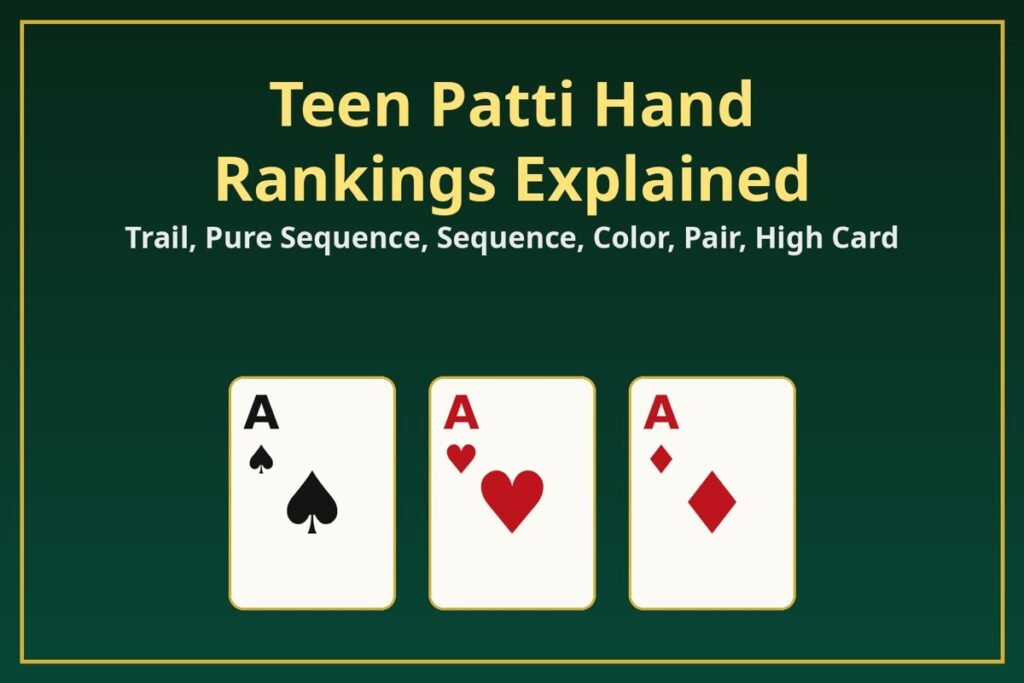
A trail in Teen Patti means three cards of the same rank. In poker terminology, three cards of the same rank are three of a kind. The physical idea is familiar, but its place in the category order is different. Recognising a shared pattern is useful; assuming it has the same strength in both games is not.
A practical study method is to label your worksheet with the game and hand size before laying out any cards. Write either classic Teen Patti, three cards, or standard poker ranking, five cards. A clear label removes ambiguity before it becomes a disagreement.
The ranking order is the main difference
Classic Teen Patti orders the categories from strongest to weakest as trail, pure sequence, sequence, colour, pair and high card. A pure sequence contains three consecutive cards in one suit. A sequence contains three consecutive cards that are not all in the same suit. A colour contains three cards of one suit that do not form a pure sequence.
Standard five-card poker puts a straight flush above four of a kind, then full house, flush, straight, three of a kind, two pair, one pair and high card. A royal flush is the highest straight flush, rather than a separate kind of hand with different comparison rules.
The important learning point is not the vocabulary alone. It is the relationship between categories. Teen Patti places a sequence above a colour. Poker places a flush above a straight. Teen Patti places a trail at the top of its standard categories. Poker has several categories above three of a kind.
| Question | Classic Teen Patti | Standard five-card poker ranking |
|---|---|---|
| How many cards form the compared hand? | Three | Five |
| What is the strongest standard category? | Trail | Straight flush |
| Does a run beat a same-suit hand? | Sequence beats colour | Flush beats straight |
| Can the hand contain two pair? | No, only three cards | Yes |
| Does one shared card decide a tie? | Compare the full relevant hand | Compare the full relevant five-card hand |
Use the table as a comparison aid, not as a replacement for either game’s full rules. It does not describe every dealing procedure or every local variation.
Do not translate colour into poker flush strength
Colour is a familiar Teen Patti term for a same-suit hand that is not a pure sequence. Poker players may call the similar visual pattern a flush. The resemblance makes translation easy, but it can also make the ranking error harder to notice.
Imagine a Teen Patti hand containing nine, six and three of hearts. Another hand contains seven of clubs, six of diamonds and five of spades. The first is a colour. The second is a sequence. Under classic Teen Patti category order, the sequence is stronger.
Now imagine a five-card poker flush and a five-card poker straight. Under standard poker ranking, the flush is stronger. The fact that a same-suit pattern wins in this poker comparison does not change the Teen Patti result.
When learning, say the category and the game aloud: sequence in Teen Patti, or flush in five-card poker. That extra phrase slows down an automatic answer just enough to catch a borrowed rule. It is more useful than memorising that red cards or high cards look impressive.
Three of a kind does not keep the same position
A Teen Patti trail is stronger than a pure sequence in the classic ranking. A five-card poker three-of-a-kind hand is weaker than a straight, flush, full house, four of a kind or straight flush. The repeated rank is the same visual pattern, but the surrounding category system is not.
Do not describe a trail as unbeatable without naming the format. In standard classic Teen Patti, it is the highest category, but trails still compare by rank. Three kings are lower than three aces. In poker, three kings are only three of a kind and lose to any completed straight or higher category.
This is why a general statement such as three matching cards are always the best hand is unreliable. It removes the game from the claim. A better explanation identifies the hand size, category system and comparison being made.
For a fuller Teen Patti-only explanation, the site’s hand-ranking guide explains the categories in more detail. This comparison should not be used to infer the rules of a named app or a special variant.
The ace needs a game-specific rule
An ace can be especially confusing because its role is not captured by saying that aces are high. A hand category may permit an ace at one end of a run while still forbidding it from wrapping around the middle.
Pagat’s traditional Teen Patti description places A-2-3 above A-K-Q. Other published house formats can use a different order, so you should confirm the sequence order rather than assume that every table follows one convention. State the chosen convention before comparing hands.
In standard five-card poker, A-2-3-4-5 is a five-high straight, the lowest straight. Ten-jack-queen-king-ace is the highest straight. A hand such as queen-king-ace-two-three does not become a straight by wrapping around the ace.
Notice how different these questions are. Teen Patti asks how the permitted three-card runs are ordered. Poker asks how a completed five-card straight is ranked. Copying the answer from one game into the other can reverse the result.
Suits do not automatically break every tie
A beginner may remember a suit order from another card game and apply it without checking. Standard poker does not use a suit hierarchy to decide which of two otherwise equal poker hands wins. A heart is not automatically stronger than a spade merely because somebody prefers that suit.
Classic Teen Patti comparisons also should not acquire an invented suit rule midway through a round. The traditional description uses category and card ranks, with specific procedures for equal hands at a show or side show. Those procedures are not the same as saying that one suit always wins.
There is a further distinction in poker: a suit rule may be used for an administrative purpose, such as assigning seats, without becoming a hand-ranking rule. Do not confuse a procedure for organising a game with a rule for comparing completed hands.
For an educational exercise, use examples with clearly different ranks first. Introduce exact ties only after everybody understands the ordinary comparison. Record any local convention separately instead of quietly presenting it as universal.
Compare the category before the highest card
The highest visible card is not the first question in every comparison. First identify the hand category. Only compare individual ranks after the category relationship has been settled.
In Teen Patti, a pair of aces does not defeat a sequence simply because aces are high. The sequence belongs to a stronger category. Likewise, a five-card poker pair of aces does not defeat a straight. Category comes before the impressive-looking card.
Within the same category, the correct comparison depends on that category. For pairs, compare the paired ranks first, then the remaining relevant card or cards if necessary. For high-card hands, compare the highest card, then the next card when the first comparison is equal.
This method is more dependable than judging a hand by appearance. Sort the cards for reading, name the category, compare categories and only then apply the appropriate tie-break. The process is useful even when you already know the answer, because it makes your explanation clear to another learner.
A small worksheet can expose borrowed rules
You do not need to play a full round to practise the differences. Use a physical deck and a sheet divided into two labelled columns. Keep all cards face up and do not introduce stakes, rewards or redeemable counters.
In the Teen Patti column, place a sequence beside a colour. Ask which category wins and why. In the poker column, compare a straight with a flush. The purpose is to say the opposite category relationships correctly, not to guess quickly.
Next, compare a Teen Patti trail with a pure sequence. Then compare poker three of a kind with a straight. Again, explain the category order rather than using a vague statement that matching cards are stronger.
Finally, write one ace example for each game. Note the exact Teen Patti convention used and the standard poker wheel straight. If an example is ambiguous because the house convention has not been named, mark it unresolved. Recognising missing information is a correct learning result.
Keep dealing rules separate from ranking rules
Knowing the order of hands does not tell you how every round proceeds. Teen Patti has its own concepts of blind and seen play, packing, side shows and shows. Poker formats have their own dealing and action rules. Similar words do not guarantee identical procedures.
This article deliberately does not combine those systems into a hybrid game. If your group wants to learn a complete format, choose one written ruleset and follow it consistently. Do not import a poker action merely because it sounds familiar or remove a Teen Patti procedure because it does not appear in a poker chart.
For a learning session, you can avoid action procedures altogether. Deal face-up example hands and compare them. That is a ranking exercise, not a complete round, and describing it honestly prevents confusion.
If someone asks how an online product handles a disputed situation, a general card-game guide cannot answer on the product’s behalf. You would need that product’s current rules. This article makes no claim about app availability, account safety, financial outcomes or legal permission to participate.
A better way to explain the difference to a newcomer
Start with one sentence: these games share a deck, not a complete ranking system. Then show one example where the category order differs. A sequence-versus-colour Teen Patti comparison is often more memorable than a long speech about similarities.
Let the learner name each category before deciding which hand is stronger. If they choose the wrong answer, ask which game’s chart they were using. That question identifies the source of the mistake without turning the exercise into a test of confidence.
Avoid statements such as poker is harder or Teen Patti is simpler for everyone. Difficulty depends on the task being learned, the format and the learner’s experience. What matters here is keeping the rules distinct.
End the exercise when the learner can explain the difference in their own words. There is no need to add money, competition or a long session to demonstrate understanding. A short, clear comparison can be a complete lesson.
Frequently asked questions
Is Teen Patti just three-card poker?
That label is too loose for learning the rules. Classic Teen Patti has its own category order and round procedures. It should not be confused with standard five-card poker ranking or a different game marketed under a similar three-card name.
Does a colour beat a sequence in Teen Patti?
Not in the classic category order described here. A sequence beats a colour. Standard five-card poker uses the reverse relationship for its corresponding categories: a flush beats a straight.
Is a trail the same as poker three of a kind?
Both contain three cards of one rank, but their place in the ranking system differs. A trail is the strongest classic Teen Patti category. Standard five-card poker has several categories above three of a kind.
Is A-2-3 always the highest Teen Patti sequence?
Pagat’s traditional description ranks it highest, but house conventions can differ. Confirm the convention before comparing hands. In standard five-card poker, A-2-3-4-5 is the lowest straight, not the highest.
Can I compare hands without playing for money?
Yes. Adults can study face-up examples with an ordinary deck and no stakes, payments, prizes or redeemable counters. A ranking exercise does not require a complete competitive round.
Does this guide explain an online app’s rules?
No. It compares classic Teen Patti with standard five-card poker hand ranking. It does not verify an app’s current rules, features, availability or financial claims.