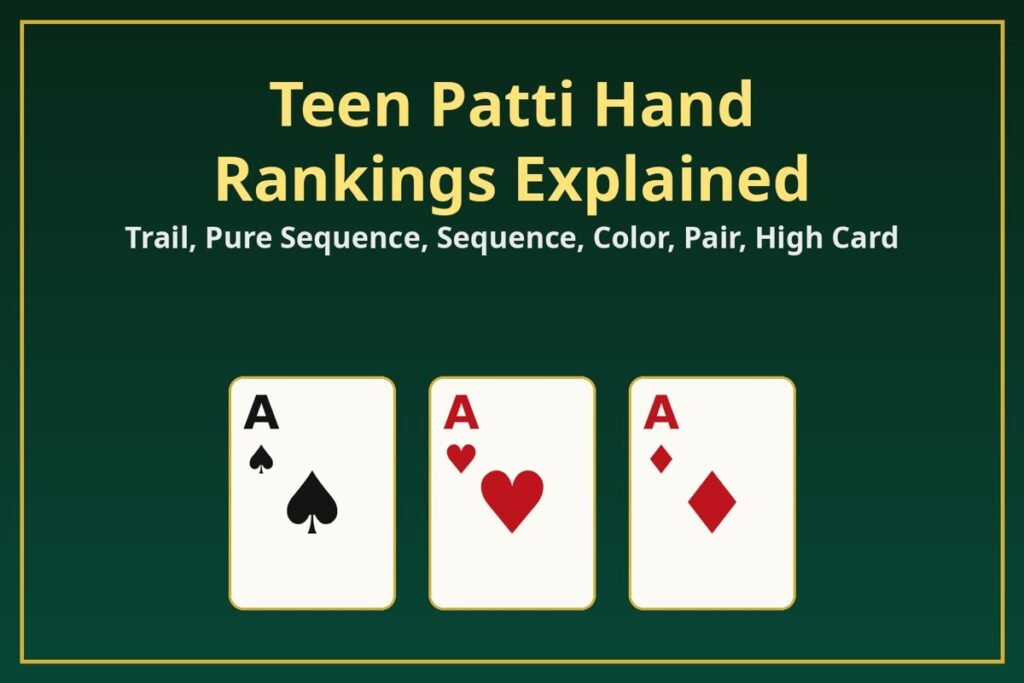
A calm card-game session starts before anyone receives a hand. The deck should contain the intended cards, the table should make dealing easy, and the group should know what to do if the deal goes wrong. These small preparations are less exciting than comparing a trail with a pure sequence, but they prevent a surprising amount of confusion.
This is an adult education guide for a physical, no-money Teen Patti learning session. There are no deposits, prizes, purchases, cash stakes or redeemable counters involved. It focuses on the cards and the dealing process, not app features or ways to profit. The suggested misdeal procedures are practical house agreements, not a claim that every Teen Patti table uses one universal rulebook.
TL;DR: What should you check before dealing?
Use one complete standard deck of 52 cards for classic Teen Patti. Set jokers and unrelated cards aside. Check that each suit contains one of every rank, and replace cards that are difficult to read or distinguishable from the back. Decide who deals, how cards move around the table and what happens if a card is exposed or a hand receives the wrong number. If the deal becomes uncertain, stop and reset under the agreement rather than improvise a rule that favours a particular hand.
Separate a deck check from an accusation
A deck check is ordinary preparation. It does not mean that you suspect somebody of cheating. Cards get mixed between boxes, a joker stays in a pack, or one card falls under a chair. Treating every irregularity as a personal accusation makes a simple problem harder to fix.
Frame the check as something the whole group does together. Put the deck face up, organise it and confirm the contents before the learning session begins. Nobody needs to surrender personal belongings or prove their honesty. The object being checked is the deck.
Use neutral language when you notice a problem. Say that there appear to be two queens of hearts, or that one card has a folded corner. Avoid guessing who caused it. A visible fact is enough to justify pausing and replacing the pack.
This approach is especially useful when several adults bring cards from home. Choose one deck for the session and keep the other packs away from the dealing area. Fewer loose cards make mistakes easier to spot and easier to explain.
Know what a standard classic deck contains
Pagat’s traditional Teen Patti rules describe an international 52-card pack. For a classic learning session, that means four suits, with thirteen ranks in each suit: ace, two through ten, jack, queen and king.
A pack sold in a shop may also contain jokers, advertising cards or instruction cards. Those extra cards do not become part of classic Teen Patti simply because they were inside the same box. Put them aside before checking the standard deck.
A joker variant is a different choice and should be named as such. Do not quietly add a printed joker to a classic exercise or assume that a variant’s wild-card treatment applies. The purpose of this guide is to make the materials clear, not to blend several formats.
You can count the pack and still miss a substitution. A deck with two copies of one card and another card missing can have the correct total. That is why checking by suit and rank is more useful than counting alone.
Sort the deck so missing and duplicate cards become visible
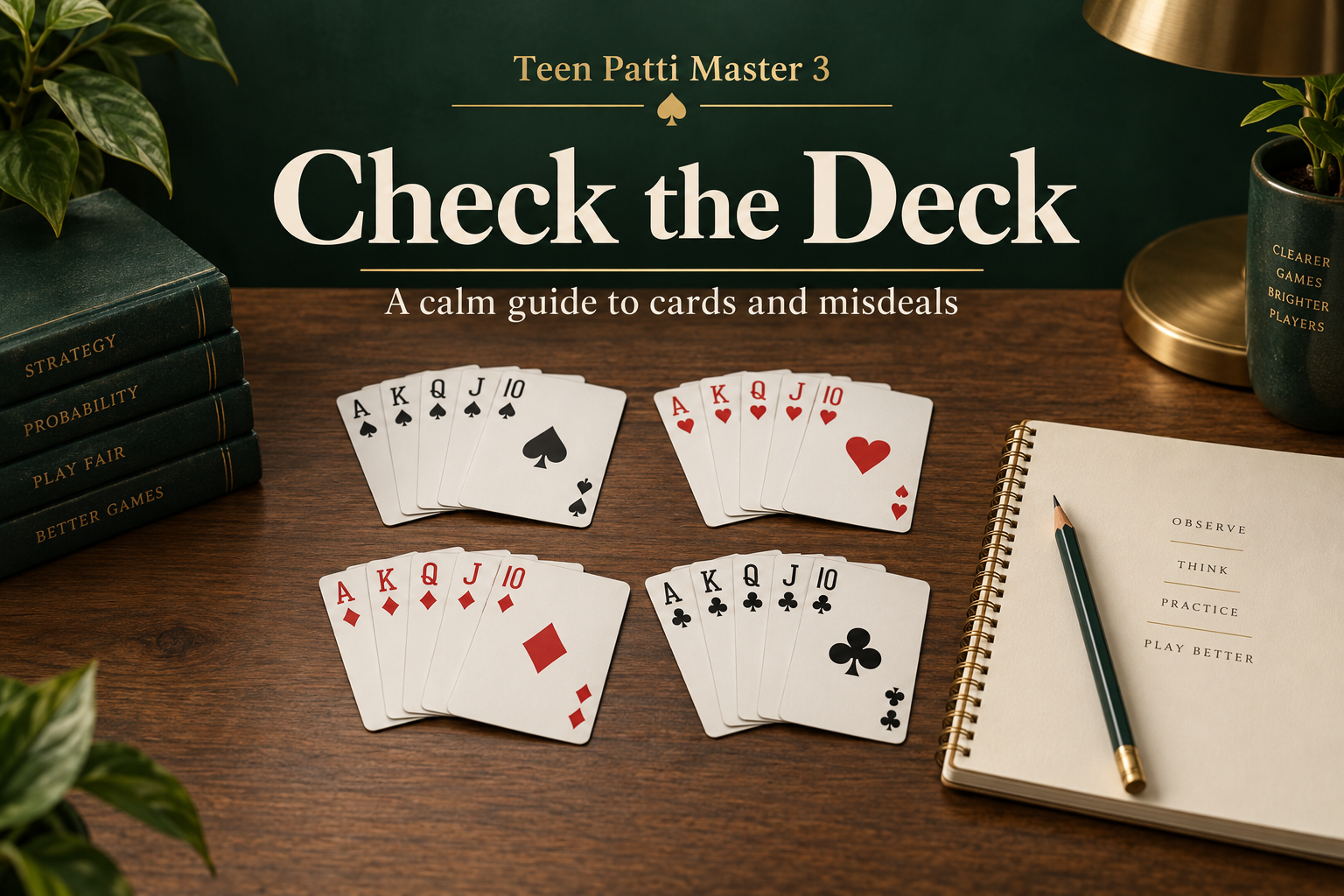
Lay out four suit groups on a clear surface. Within each group, place the cards in the same rank order. The exact direction is less important than consistency. Each group should contain one ace, one of each numbered rank and one jack, queen and king.
Now scan each group rather than trying to remember which cards you have already seen. A missing seven or a second queen is easier to notice in an ordered row. If space is limited, check one suit at a time and return the verified group to a separate pile.
If something does not match, do not repair it by borrowing a similar-looking card from another pack without checking the backs. A replacement with a different back design can identify itself while face down. A complete replacement deck is often the simplest solution.
After the contents have been checked, gather the cards and shuffle before any learning exercise that relies on an unknown order. A sorted pack is useful for inspection, but it should not accidentally become the next deal.
Look at the backs as well as the faces
Readable faces are only half of the check. In a face-down game, the backs should not reveal which card is underneath. Turn the deck over and look for obvious differences in design, colour, wear or damage.
A folded corner, deep scratch, large stain or distinctive sticker can make one card recognisable. The point is not to teach people to exploit such differences. It is to remove the difference by replacing the card pack before the session begins.
Do not try to conceal a mark with ink, tape or an improvised repair. The repair may create a new identifying feature and can make the card harder to handle. Put the questionable deck aside for another purpose, such as open-card teaching where every card is visible.
This check should be brief and shared. It is not a forensic investigation, and a casual group should not pretend that it can certify a deck against every possible problem. If the materials do not inspire confidence, choose another pack and move on.
Choose a surface that makes the cards easy to manage
Use a stable, dry table with enough room for each participant’s cards. A crowded surface creates avoidable problems: cards slide under plates, get mixed with another hand or become difficult to pick up without exposing them.
Keep drinks away from the dealing path. Remove loose cards from other games, receipts and unnecessary objects. Good light helps people distinguish ranks and suits without repeatedly lifting cards towards other players.
If a participant has difficulty reading small indices, choose a more readable deck before the session rather than asking them to struggle through every comparison. You can also use face-up examples for teaching. Accessibility is a reason to adjust the materials, not a reason to rush somebody.
A tablecloth or mat can make handling comfortable, but it should lie flat and stay in place. The useful test is practical: can the dealer move one card at a time and can everyone keep their hand separate? Decorative equipment is not required.
Agree the dealing procedure before the first hand
Pagat describes dealing cards one at a time until each player has three. For a learning session, make the intended direction and starting seat clear before dealing. A simple verbal check prevents a later disagreement about whether somebody received the correct next card.
Choose who deals first and how the role changes between exercises. If one participant is learning to deal, say so and allow practice. The group does not need to interpret an uncertain hand movement as a competitive advantage.
Keep undealt cards in one clear place. Do not mix them with completed practice hands or cards that have been set aside. If a person is observing rather than participating, give them a separate example hand only when it cannot become confused with the active deck.
You can make the first deal face up to demonstrate the process. Label it a demonstration, gather all the cards afterwards and reset. A demonstration is not a live hand that must somehow continue after everyone has seen the cards.
Write a small misdeal agreement
A misdeal agreement answers a practical question: if the setup fails, how do we stop and restart fairly? There is no need to wait until a player likes their cards to decide whether an error matters.
For a no-money learning session, a simple approach is to stop when the group cannot establish that the cards were dealt correctly. Gather all hands and undealt cards, check the pack if necessary, shuffle and begin again. Nobody gains or loses anything of value through the reset.
Put the agreement in plain language. It should cover an exposed card, a wrong hand size, a dropped card and uncertainty about which cards belong to which hand. It should also say who announces the pause, ideally anyone who notices a problem.
Do not present this proposed reset procedure as a universal tournament rule. Organised events and particular variants may have their own procedures. This guide offers an adult study-session method whose purpose is clarity, not a substitute for an event’s published rules.
| What happens | First response | Sensible learning-session reset |
|---|---|---|
| A card is exposed during dealing | Pause before continuing | Gather the cards and deal again under the agreed rule |
| Someone receives the wrong number | Keep all hands separate | Recount, then reset the entire demonstration if uncertain |
| A card drops out of view | Stop handling the remaining deck | Recover it, check the pack and restart if confidence is lost |
| Two hands become mixed | Do not guess ownership | Gather, shuffle and start a fresh exercise |
| A duplicate or missing card is found | Set the deck aside | Use a verified complete replacement pack |
What to do when a card turns face up
An exposed card can change what people know about a hand. The useful response is immediate and neutral: stop the deal and identify what happened before more cards move.
Do not allow a participant to decide whether the error counts only after inspecting their own cards. That creates an avoidable conflict between the procedure and the result they prefer. The pre-agreed reset rule should apply regardless of whose hand appears strong.
In a face-up teaching exercise, exposure is not itself a problem because all the information is meant to be visible. This is another reason to name the exercise clearly. A learning demonstration and a face-down round do not have the same information conditions.
If the group disagrees about what was visible, do not demand certainty that nobody has. A fresh demonstration costs little in a no-money session. Pausing and restarting is often better than spending the rest of the evening debating an uncertain glimpse.
What to do when somebody has too many or too few cards
Count the cards without mixing the hands. Check whether the dealer skipped a seat, dealt an extra card or lost track of the order. Do not simply remove whichever card someone likes least or let them choose a replacement.
Choosing after seeing the hand changes the exercise. Even where nothing valuable is at stake, it teaches the wrong lesson about how to handle an error. The correction should come from the agreement, not from a player’s preference.
If the group can no longer identify the correct dealing sequence, reset the whole demonstration. Gather the hands and remaining deck, shuffle and deal again. That is simpler than pretending a guessed repair recreates the original deal.
Afterwards, consider the cause. Perhaps the seats were unclear, the cards stuck together or the dealer was distracted. Fixing that small issue is more useful than assigning blame. A clean restart should make the next attempt easier.
Keep discarded and undealt cards distinct
Cards that have left a demonstration should not drift back into the undealt pack halfway through it. Keep separate areas for the remaining deck, active hands and cards gathered after an exercise ends.
When the exercise is over, collect everything deliberately. A quick count can reveal a card left under a hand or near the table edge. If the count is wrong, find the missing card before the next shuffle rather than carrying the uncertainty forward.
For a short learning session, one pack is enough. Switching between several similar packs may create more confusion than convenience. If you do use a replacement, put the first pack back in its box and clear the surface before opening the next one.
This is a materials habit, not a strategy for reading opponents or predicting cards. The goal is to know that everyone is using the same complete deck under the same stated conditions.
Use an incident as a teaching pause, not a contest
A dealing mistake gives the group a chance to practise a fair response. Ask what is known, what remains uncertain and which agreed procedure applies. Keep the explanation about the process rather than the quality of anyone’s hand.
If a newcomer makes an error, demonstrate the movement slowly and let them try again. Do not turn a basic handling problem into a joke at their expense. Learning with cards face up can remove pressure while they understand the sequence.
If the session becomes tense, stop. A no-money educational activity has no result important enough to justify an argument. The group can return to simple hand comparisons, take a break or finish for the day.
A calm reset is a successful outcome. It shows that the procedure matters more than defending a result produced by uncertain materials. That habit is worth learning before any more complicated rules are introduced.
For the separate question of table manners, see the site’s Teen Patti etiquette guide. This deck-check article deals with materials and errors, rather than replacing that discussion.
A short checklist to keep beside the deck
Before the session, confirm one complete 52-card classic deck, no unwanted jokers, matching backs and readable faces. Clear the table and put other packs away. Name the dealer, direction and starting place.
Before each demonstration, say whether the cards will be face up or face down. State that the exercise has no money, prizes or redeemable items. Keep each hand separate and leave the undealt pack in its agreed place.
If something goes wrong, pause immediately. Do not change the error procedure to suit the cards somebody holds. When the deal cannot be reconstructed confidently, gather everything and begin a fresh demonstration.
At the end, collect and count the cards, then return them to their box. These habits are small enough to use consistently. They help the next session start with a clear deck rather than an unresolved question from the previous one.
Frequently asked questions
Does classic Teen Patti use printed jokers?
The traditional classic description uses a standard 52-card pack. Printed jokers are not automatically included. A joker variant is a separate format that should be named and explained before the exercise.
Is counting 52 cards enough to verify the deck?
No. A duplicate can replace a missing card while leaving the total unchanged. Sorting by suit and rank helps confirm that each intended card appears once.
Should we continue if a card is exposed during dealing?
Follow the procedure agreed before the deal. For the no-money learning session described here, pausing and starting a fresh demonstration is a simple option when the deal is uncertain.
Can a player choose which extra card to return?
That is not a neutral repair after they have seen the cards. Use the pre-agreed procedure. If the correct deal is unclear, reset rather than letting someone choose the correction that suits them.
What if one card has a distinctive bent corner?
Use a different complete deck. A recognisable back or edge can reveal information while the card is face down. An improvised repair may create another identifying mark.
Are these official tournament misdeal rules?
No. The deck composition is grounded in a traditional rules reference, while the reset procedures are clearly labelled suggestions for adult, no-money learning. An organised event must use its own published procedures.